
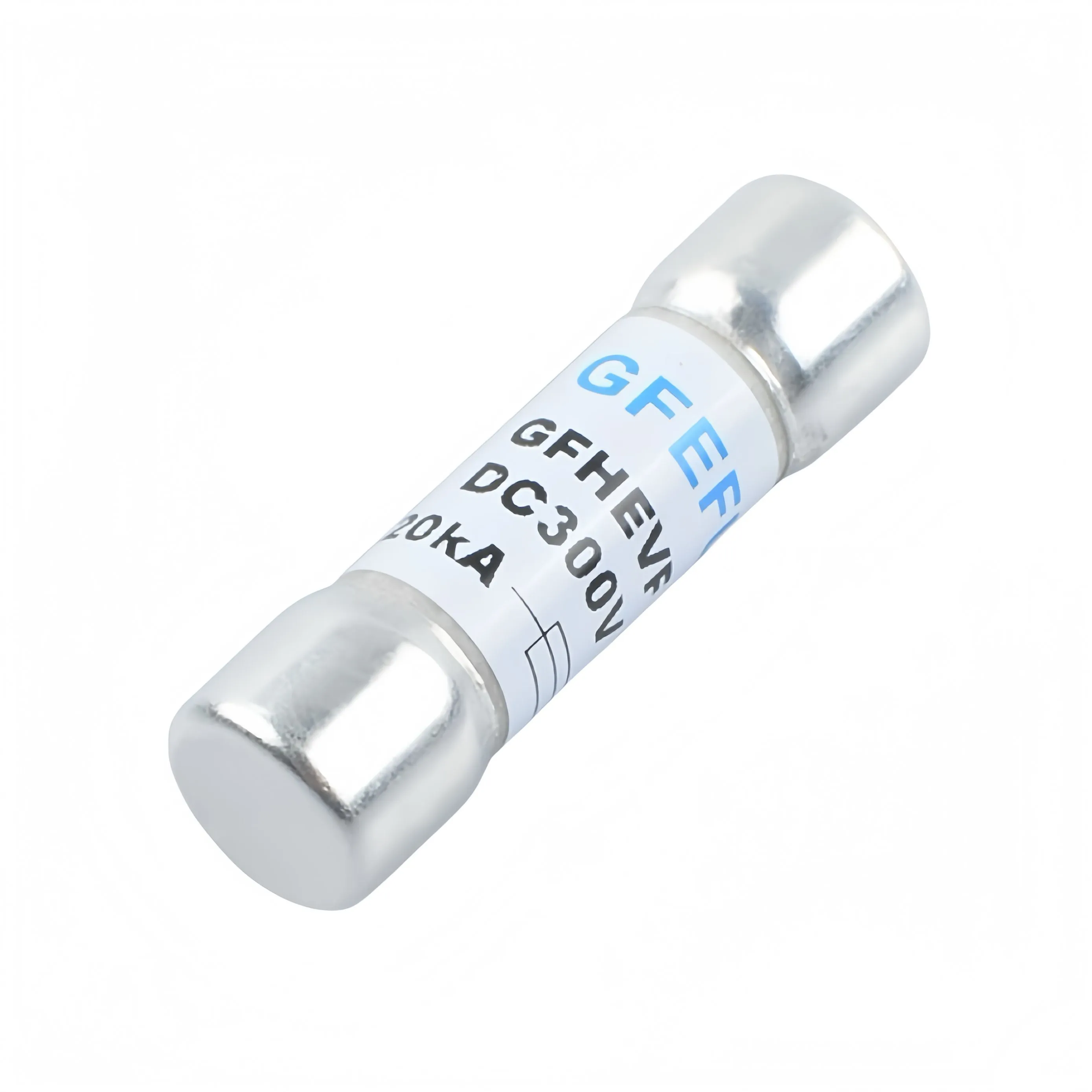
The most common specification error we see is not the current rating. It is someone matching the voltage rating of a DC fuse to the nominal system voltage and calling it done. On AC, that habit is mostly harmless. On DC, it is the difference between a device that clears and a device that becomes a heater. This article explains why DC interruption is fundamentally harder than AC interruption, and how much voltage margin a DC fuse actually needs.
Alternating Current Gets a Free Reset Twice a Cycle
An AC fault current passes through zero a hundred or a hundred and twenty times a second. Every one of those zero crossings is a moment when the arc inside the fuse has no current sustaining it, and the dielectric strength across the gap has a chance to recover. Fuse designers rely on this. The arc cools slightly at each crossing, the ionised gas between the element fragments recombines, and the voltage required to restrike the arc rises. If recovery outpaces the rising system voltage, the arc dies on its own. Direct current never crosses zero. There is no free reset, no cooling pause, and no recovery window. The arc has to be defeated by force.
What Actually Happens Inside a DC Arc
When the element melts under DC fault current, an arc forms across the gap and keeps conducting. To stop it, the fuse has to drive the arc voltage above the system voltage that is pushing current through it. It does this by stretching the arc, splitting it into multiple series arcs at the element's notches, and cooling it against the filler material — usually quartz sand — packed inside the body. Every one of those mechanisms takes energy, and the energy scales with the voltage it has to overcome. A device asked to interrupt 1000 V DC must generate and absorb far more arc energy than the same physical device interrupting 400 V DC. This is why DC-rated devices are physically different from their AC counterparts even when the current rating is identical: longer bodies, more sand, more element notches, more robust end caps. The voltage rating is a statement about arc management, not a label.
Why the Voltage Rating Is an Arc-Energy Statement
When a manufacturer prints 1000 V DC on a fuse, they are certifying that under specified test conditions the device absorbs enough arc energy to extinguish the arc at 1000 V. That is the whole meaning of the number. So applying a device at its exact rating leaves no margin for the ways real circuits differ from test circuits:
- Loop inductance stores energy and prolongs the arc
- Higher ambient temperature reduces the filler's ability to absorb energy
- A device that has already seen thermal cycling behaves differently from a fresh one
- Real fault currents are estimates, not measurements
That combination is why good practice applies margin rather than matching the number exactly.
Constant Power Loads Make It Worse
Many DC systems are fed by or feeding constant power devices — inverters, converters, motor drives. A constant power load has a negative incremental impedance: as input voltage falls, it draws more current. During an interruption, this works against the fuse. As the arc voltage rises and the voltage available to the load falls, a constant power load responds by demanding more current, which feeds the arc. The device has to win against a load that fights back. This behaviour is absent from a simple resistive circuit and is one reason bench tests on resistive loads can look more optimistic than field behaviour.
Inductive Loops Add Stored Energy
Every real DC loop has inductance: cable, busbar, contactor, the battery itself. Energy stored in that inductance, equal to half L times i-squared, has to go somewhere when the circuit opens. It goes into the arc. The longer the loop inductance and the slower the time constant, the more energy the fuse must absorb during interruption. This is why DC breaking capacity is specified against a time constant, and why a rating valid at one millisecond may not hold at ten. When you read a datasheet, find the time constant used for the published figures. If your loop is slower than the test condition, the effective capability is lower, and that gap is where failures live.
How Much Margin Is Enough
There is no single multiplier that suits every application, and any rule of thumb should be confirmed against the datasheet. That said, here is how we approach it in practice:
- The voltage rating must meet or exceed the maximum system voltage, including regenerative overshoot, charge voltage, and any transient the design permits
- For battery circuits, use the maximum state-of-charge voltage, not the nominal voltage
- For photovoltaic, use the cold-temperature Voc, not the standard-condition figure
- Apply additional margin where the loop is inductive, the environment is hot, or the load is constant power
- Never substitute an AC rating for a DC application, even at a numerically higher voltage
The underlying question is always the same: what is the highest voltage that can appear across this device at the moment it has to interrupt, under the worst conditions the system can produce?
What to Do If Margin Is Tight
If a higher rating pushes the device into a physically larger body than the panel allows, the options are honest ones: reduce loop inductance by shortening the fault path, improve cooling at the installation point, or reconsider the system architecture — for example splitting a high-voltage DC bus into protected segments. Compressing the voltage margin to fit an enclosure is the one option that should never be taken.
Summary
A DC fuse rating describes arc-quenching capability, not just insulation. Because DC has no zero crossing, because constant power loads fight the interruption, and because inductive loops feed the arc, the rating must sit above the worst-case system voltage rather than equal to the nominal one. Establish the true maximum voltage first, then match the device to it.
About Our DC Protection Range
GFEFUSE is the brand of Dongguan Gongfu Electronics Co., Ltd., an electronic protection device manufacturer established in Dongguan, Guangdong in 2013. We develop, produce, and sell fuses, fuse holders, and fuse boxes, backed by five advanced production lines and a thirteen-person R&D team, and our products are exported to customers overseas. Our high voltage fuse portfolio covers DC interruption across traction, storage, and industrial applications, and it is the range most customers start from when voltage margin is the driving concern. Vehicle platforms typically reference our EV fuse range, solar designs our photovoltaic fuse range, and stationary battery systems our energy storage fuse range. Products carry UL, cULus, TUV, CE, and CQC certification and comply with RoHS and REACH directives, serving new energy, power equipment, automotive electronics, communication systems, and consumer electronics.
Conclusion
Nominal system voltage is a convenient number to design around and the wrong one to select protection with. Work out the maximum voltage that can appear across the device at the instant of interruption, account for the inductive and constant-power character of the load, and choose a rating that sits above it. The alternative is a fuse that melts without clearing.
Send us your system voltage, maximum transient voltage, loop time constant, and whether the load is resistive or constant power. We will confirm the voltage rating and margin for your application.
Frequently Asked Questions
Direct answers on DC voltage rating and interruption.
Why does a DC fuse need a higher voltage rating than the system?
Because DC has no zero crossing to help extinguish the arc. The device must generate enough arc voltage to overcome the system voltage, and margin is needed for inductive stored energy, temperature, and real-world variation from test conditions.
Can I use an AC rated fuse on a DC circuit?
No, not by matching numbers. AC interruption benefits from the current zero crossing, so an AC rating says nothing about DC arc-quenching capability. Use data published for DC at your voltage and time constant.
How does loop inductance affect DC interruption?
Stored inductive energy feeds the arc during opening. The slower the time constant, the more energy the device must absorb, and the lower its effective breaking capability. Always compare your loop time constant with the datasheet test condition. In long DC busbar runs the inductance can be several hundred microhenries, which pushes the time constant well past 10 ms, and that is exactly the condition where unverified AC ratings fail first in the field.### What is the maximum voltage I should design to? The highest voltage that can appear across the device at the moment of interruption. For batteries, use maximum state-of-charge voltage. For solar, use cold-temperature Voc. Include regenerative overshoot and any permitted transient.
Does a constant power load change the requirement?
Yes. Constant power loads draw more current as voltage falls, which works against arc extinction during interruption. Systems with inverters, converters, or drives need closer attention to voltage margin than a purely resistive load.